

|
My childhood memories are full of sunny summer days at Ft. Lauderdale beach. I can still see the mounds of seaweed that had to be stepped over to get to the ocean, and feel the tickle of floating seaweed rubbing against my skin as I swam in the surf. It was fun to shake out the clusters of seaweed and see the small crabs and shrimp fall from its cover. There were other things contained in the seaweed such as black tar and the stinging Portuguese man o’ war that had to be watched out for. At the end of May this year, while seated at the ocean’s edge, those memories came rushing back to me, with a nostalgic filter of course. As a fresh batch of seaweed floated by, I admired how its light brown color was set off by the aqua of the sea and was amused by the exposed coral rocks that seemingly wore seaweed toupees, from fresh weed deposited by the high tide.  Wading birds flock to the seaweed, which is full of life. Reality check! A Miami news station had a feature about the FIFA world cup visitors who were turned off by our smelly beaches and weed filled waters. Not what they expected, especially after coming from across country or from Europe. The scourge of summer, from the viewpoint of South Florida resort managers, who have to field complaints about the stinky mess from June until September. Floating mats of fresh seaweed eventually end up onshore and become a hazard that attracts flying insects and carries contaminants and bacteria. Parents worry when their child has to wade through the junk in order to paddle board, kayak or launch a Hobie Cat. People with respiratory problems are at risk from the release of hydrogen sulfide and ammonia.  A Great White Heron waiting for low tide when the cove will be shallow enough to wade in. There will be plenty of crabs, shrimp, and small fish to be had in the sargassum accumulated below. Seaweed, also known as Sargassum, is a brown microalgae that never touches the sea floor, but instead drifts on the surface of the ocean. Its name Sargassum originates from the Portuguese word sargaço, a type of grape or also a wild vine that grows in willow thickets. The tiny balls that keep the weed afloat look like grapes. Christopher Columbus encountered a thick mat of weed while sailing in the Atlantic near the Bermuda Triangle, and with light winds prevailing, he feared getting stuck in it. Columbus had encountered the Sargasso Sea, an area that cannot be found on any map, but is defined by the convergence of four major Atlantic currents: the Gulf Stream, the North Atlantic Current, the Canary Current and the North Atlantic Equatorial Current.  Seaweed, also known as Sargassum. Its tiny balls keep the weed afloat. The Florida Keys are one stop along the Great Atlantic Sargassum Belt which spans 5,000 miles from coastal West Africa to South America. Winds and currents act like a conveyor belt that distributes the seaweed into the Atlantic and Caribbean Sea, and a “loop” current carries the seaweed around the coast of Florida into the Gulf of America. NOAA designates sargassum as essential fish habitat, for species including gray triggerfish, amberjacks and mahi mahi. In the open ocean seaweed provides food or shelter for fish, crustaceans, turtles and seabirds. When the weed hits the coastal flats, the wading birds flock to its floating mass, which is fresh and full of life. I netted a bucket of fresh weed and shook it until the critters contained within it fell out. There were shrimp and crabs galore. I marveled as the crabs would approach the shrimp and start pinching. The shrimp were translucent mini-me versions of jumbo shrimp.  I netted a bucket of fresh weed and shook it until the critters contained within it fell out. There were shrimp and crabs galore. Harvesting of sargassum is prohibited in U.S. federal waters (between 3 miles to 200 miles from shore.) Sargassum is not protected in Florida, as long as it has washed ashore naturally you can pick it up with your hands or with hand tools. In State waters up to 100 pounds of sargassum can be removed from canals or nearshore waters with a recreational fishing license. A commercial saltwater products license is needed to remove more than 100 pounds according to the FWC. Once near shore the weed makes its way into man-made canals and marinas and gets stuck. Keys boaters curse the seaweed as it fouls their props and canals get clogged with the weed. The trapped weed sinks, making the canal brown, due to the decaying weed, which depletes the oxygen in the water, resulting in fish kills.  A boat ramp covered with weed. You must wade through the junk in order to paddle board, kayak or launch a Hobie Cat. In Ft. Lauderdale small barges would run up and down the canals scooping up the seaweed with a fork. Removal is a futile process, since the seaweed floats in every day. Bubblers at the entrance to a canal may help keep it out. Seaweed has the potential for use as fertilizer; it contains nitrogen, phosphorus and potassium (NPK), the same ingredients found in fertilizer, plus micro-nutrients. Since there is arsenic in seaweed, it might be best utilized on ornamental plants and palms, not food crops.  The weed was so thick the black birds could walk on top of it.
3 Comments
Often when people move to the Keys, the first thing they try to do is make their new home just like the place they left. Locals can pick up pretty quickly who these “they do it where I come from” newcomers are; within five minutes of meeting Angela and Brian, and observing their efforts to caretake our fragile Florida Keys environment, I knew they were a good fit here. They came down as a family when their middle child Logan was transferred to Coast Guard Station Islamorada, and once here, decided not to leave. Jokingly Brian and Angela aways said, “when the kids are gone we are going to quit our jobs, run away to the Keys and become bartenders, live in a one room shack with an A/C that is halfway broken and they wouldn’t care if there are roaches!” A positive twist on the old story “Come on vacation… leave on probation.” 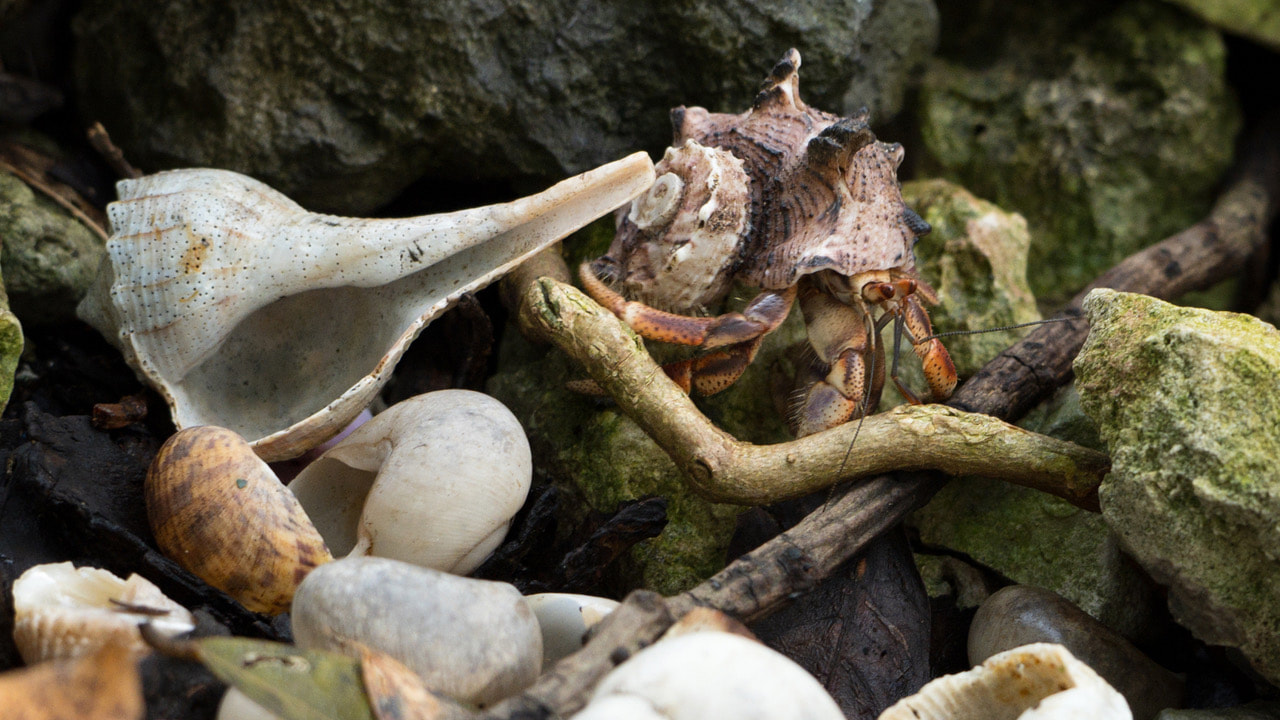 A crab blends in with the rocks and shells scattered in the woods. They researched house prices, and soon realized they couldn’t quit their jobs and become bartenders. Luckily, their jobs allowed them to work from anywhere, so they got more of their full dream than most anyone would want. The house they found online, located in Harry Harris Park, from an aerial view on Zillow, was your typical pea rock yard and stilt house property. The backyard borders a natural mangrove and buttonwood preserve, which if you were to crawl a few hundred yards through the County owned property, you could reach the shoreline. Soon after moving in Angela noticed shells near the A/C condensate drainpipe, picked one up, and saw it was a land hermit crab (Coenobita clypeatus). In honor of their new-found friends, Brian and Angela named their property ~ “Crustacean Plantation”. Never having had a hermit crab as a pet, her first reaction was “I don’t know how this works,” but she learned. She started by counting her hermit crab encounters, and began numbering the shells. At some point past 100 crabs she stopped counting. 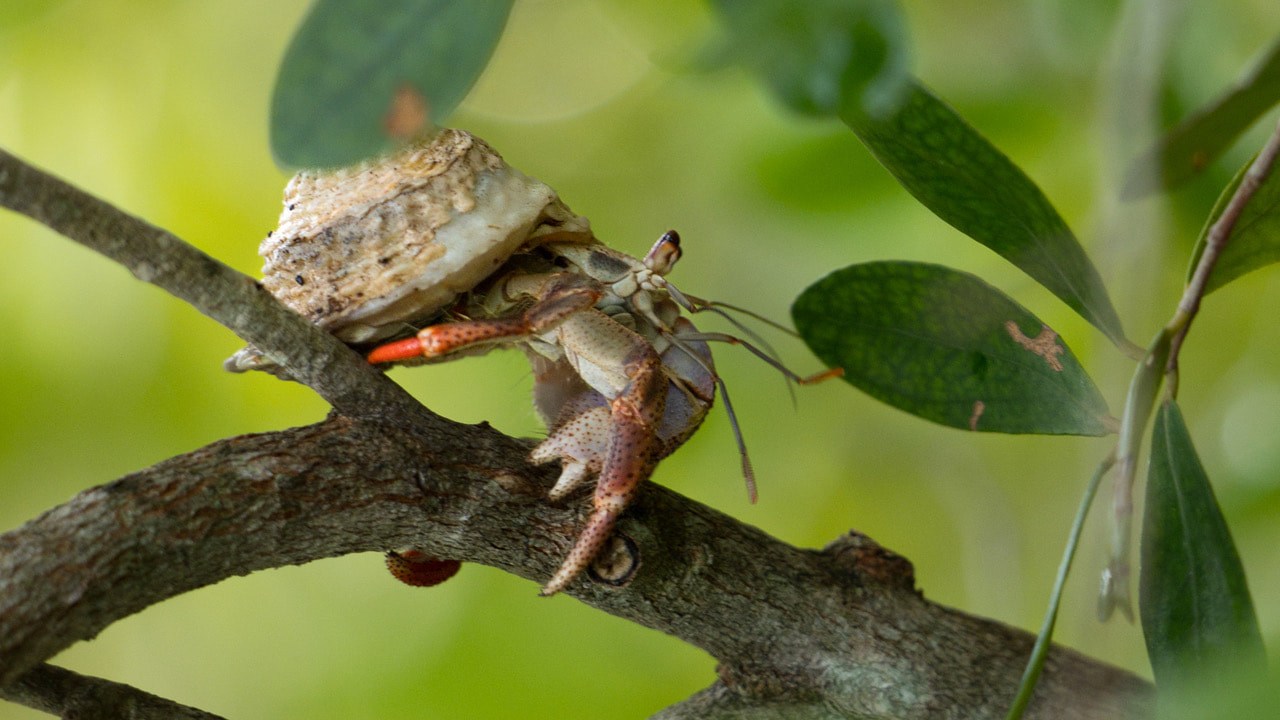 Hermit crabs make there way from the ground up into the trees and everywhere in between. 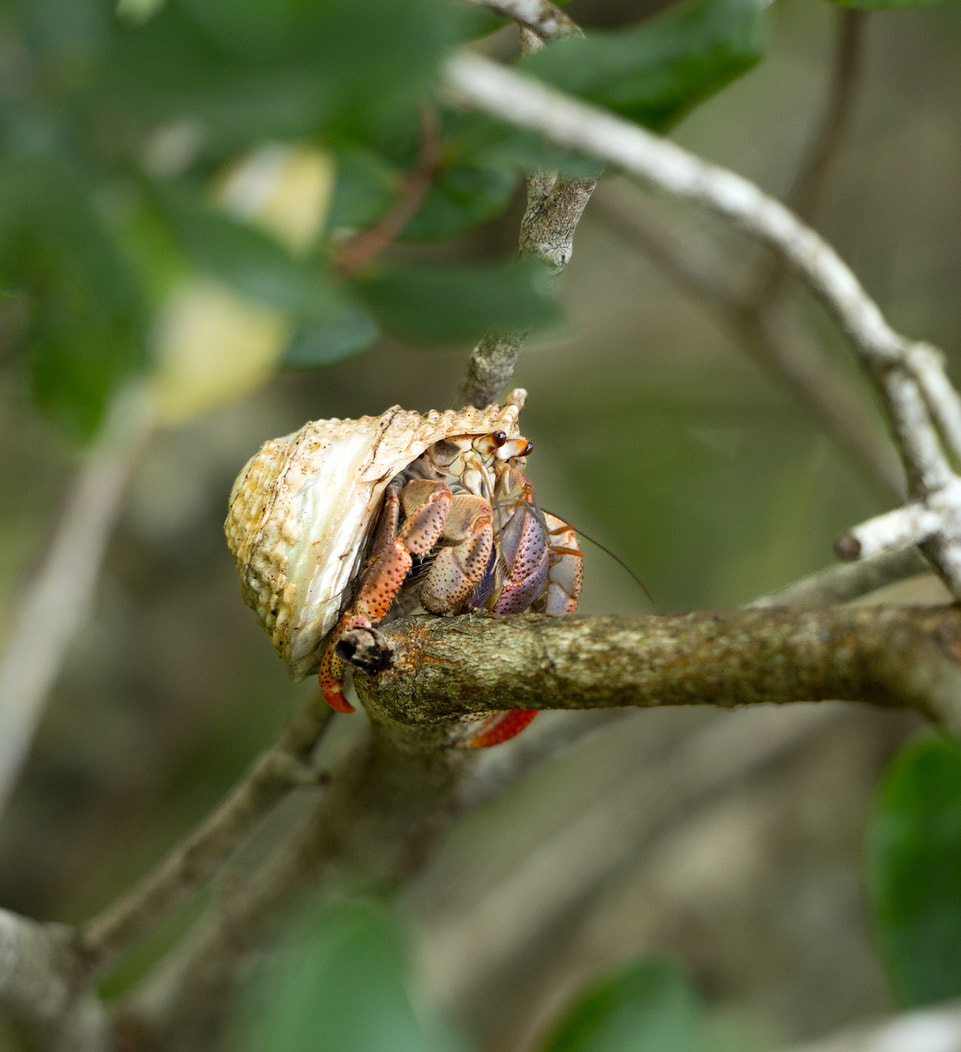 Hermit crabs have soft abdomens which require protection of a shell, and who require bigger shells to suit their bodies as they grow. She observed encounters where one crab was trying to hijack another crab’s shell. A crab will approach a shell, be it occupied or not and tap on it with it’s own shell. If it is occupied it will continue it’s incessant thumping until the resident crab gives up the shell willingly, or is evicted by force. Lost pinchers or legs found on the ground, are evidence of crab shell fights. Realizing a need, Angela started purchasing shells to put out in a designated “Transfer Station” and almost immediately small or broken shells were traded off for the new and roomier models, kinda like a used car lot for hermit crabs. Broken shells are left vacant, as they no longer provide protection or cannot hold fresh water needed to lubricate the crab’s gills. 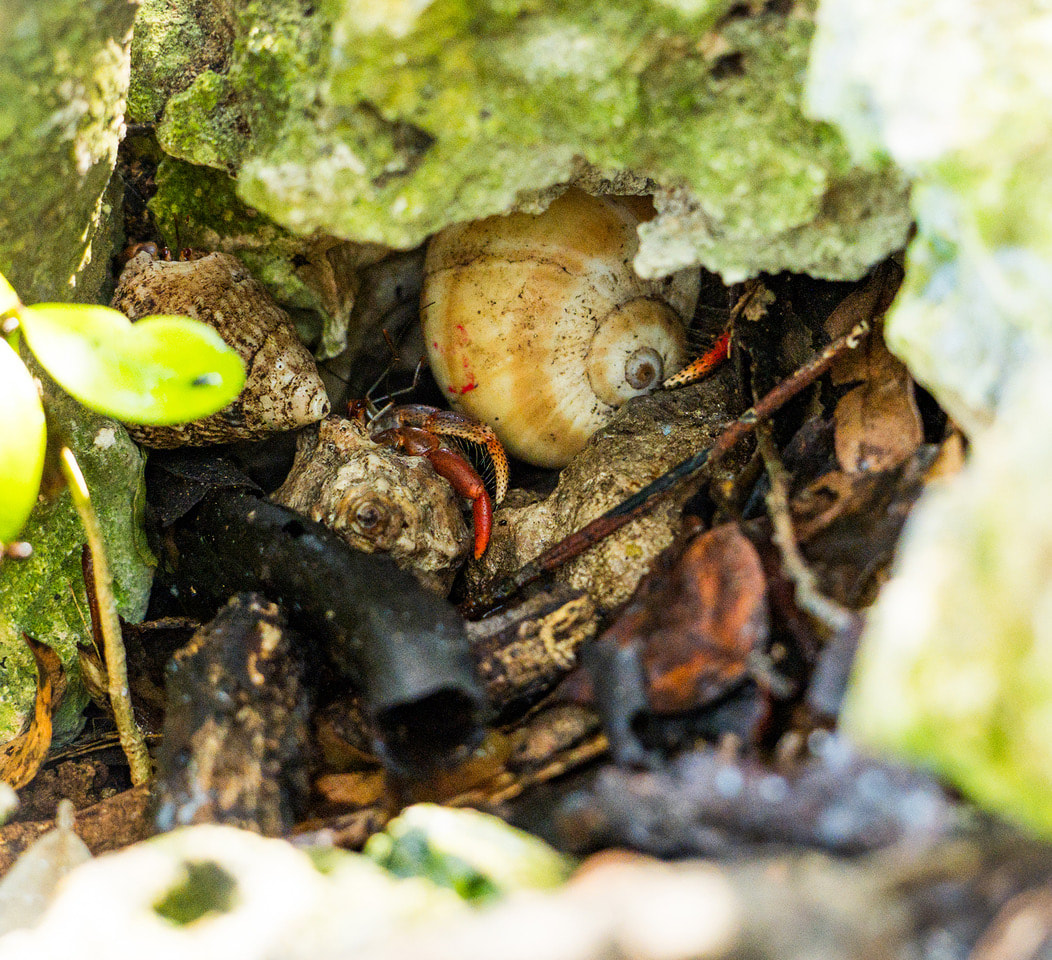 Hermits crabs are social animals, despite their name, pile onto each other beneath a coral rock ledge. Angela and Brian have spent hours in the garden, adding mulch and soil, making new beds for the native and flowering plants, and adding water sources for the critters. Bricks and boulders line the raised beds full of soil and mulch. Hermit crabs need soil or sand substrate in order for them to molt; since the Keys doesn’t have dirt, the hermit crabs must surface molt or find leaves, and bury themselves during this vulnerable time. In their new beds, Angela and Brian have seen little dig piles where a hermit crab has gone to molt. We have provided them a “crabitat” - something they probably wouldn’t normally have. 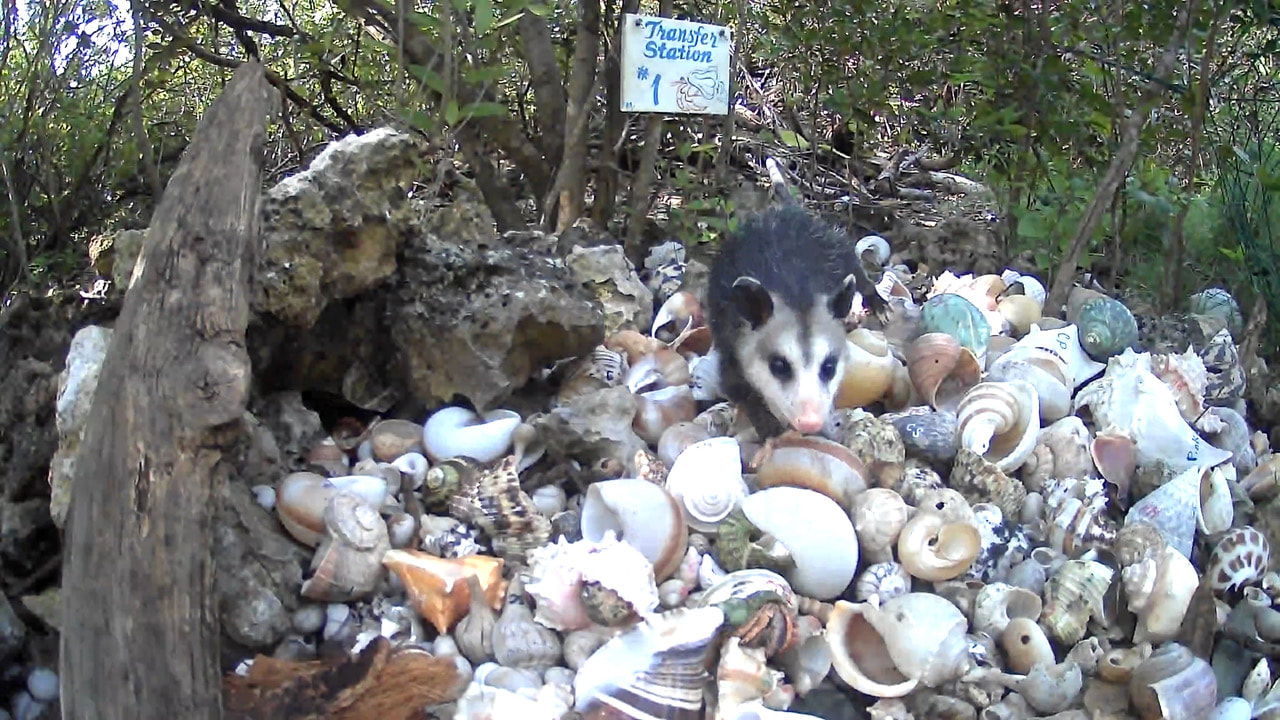 A surveillance camera captures this opossum cruising through the shells. Squirrels, possums, raccoons, birds, lizards, iguanas, anoles, and land crabs live here. The “Transfer Station” is where Angela puts out shells for the hermit crabs who are always on the quest for the perfect shell. 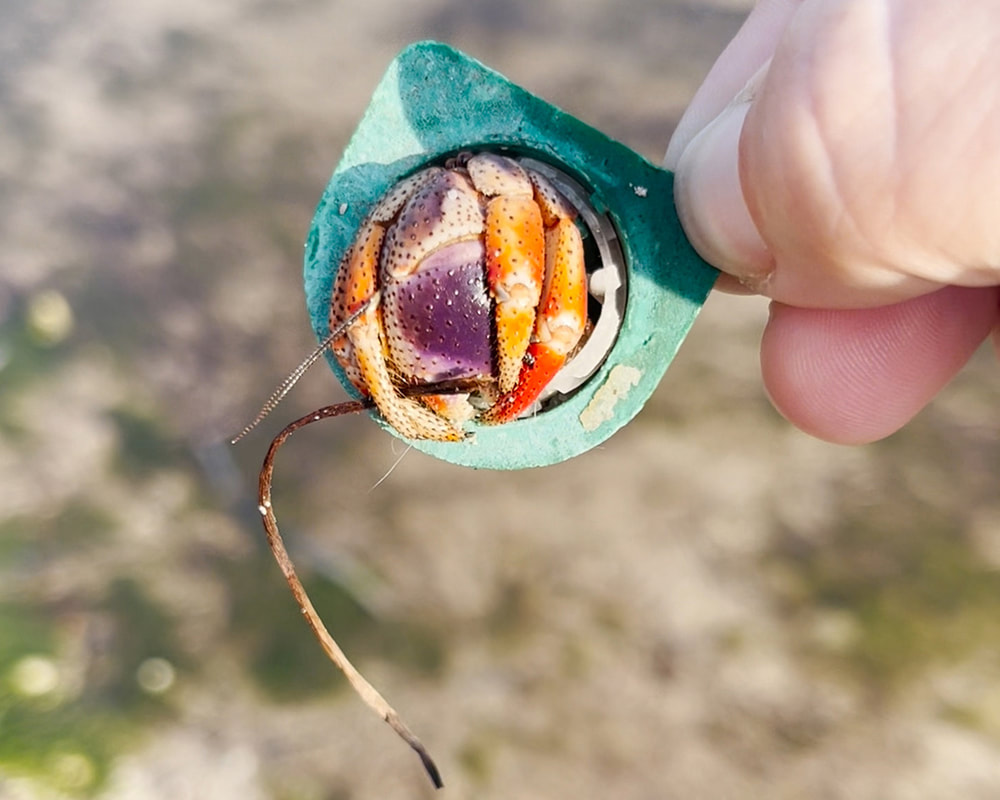 A crab mistakes a plastic bottle cap for a new home. According to the Journal of Hazardous Materials , 570,000 hermit crabs die annually on two South Pacific islands from getting stuck in plastic debris. Photo by Capt. Deb Deyo Creeping zoysia grass covers the former barren pea rock yard, leading up to an undisturbed tidal rocky area in the back of the property where the crabs hang out. As we approach we can hear clacking as the crabs retreat and their claw clamps shut the shell opening; hermit crabs have keen eyesight so it is hard to sneak up on one. We stare at the rocks, and soon detect movement; a shell blending in perfectly contains a hermit crab on the move. A sign “Hermit Highway” designates where the crabs cross to go to the ocean to lay their eggs, and after having done so return to the dry land to resume their lives. 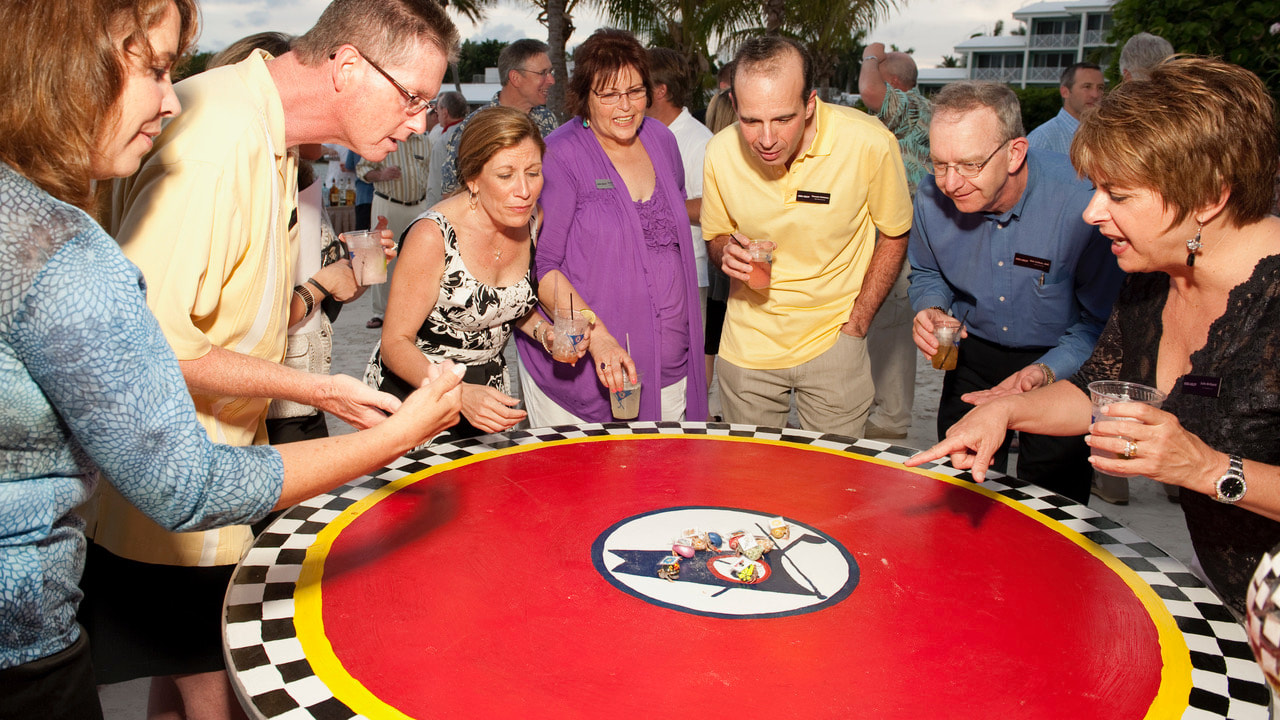 Hermit crab racing is a sport imported from the Caribbean. Crabs are placed in the center a table, which has a ring painted in the center. The first crab to crawl past the outer ring is the winner-winner, crab dinner. 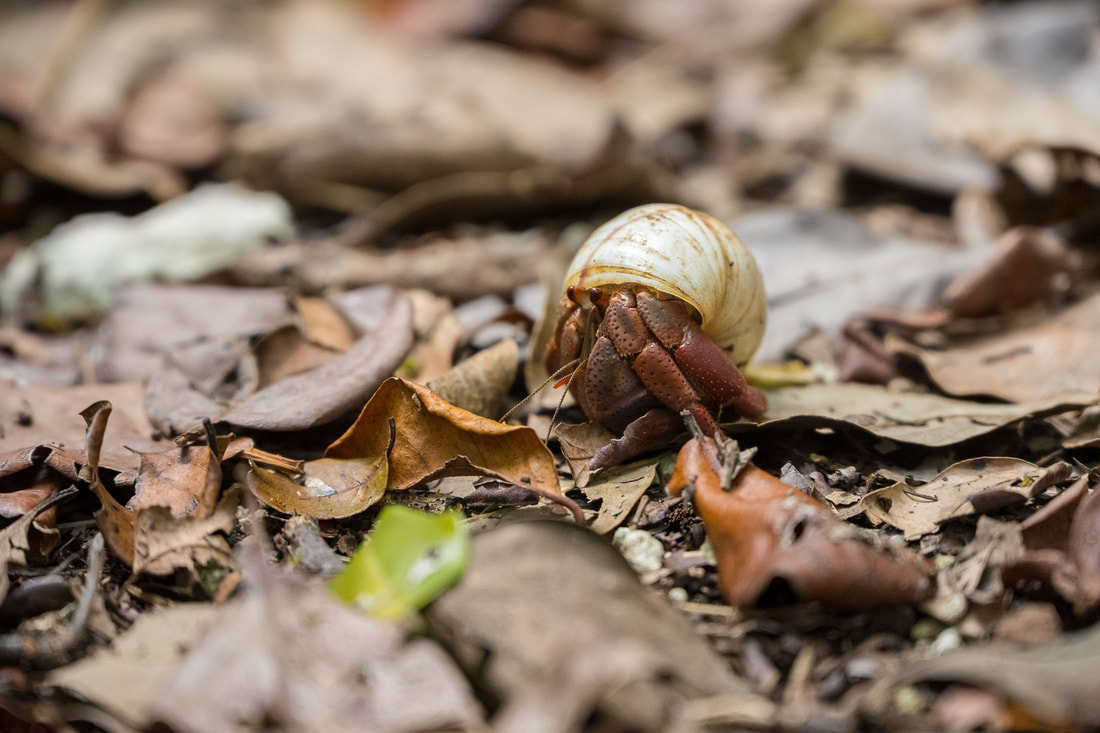 A hermit crab in the hardwood hammock sporting a tree snail shell. The “Crustacean Plantation” is on the Garden Club of the Upper Keys garden walk, Sat. Feb 17, 2024. It is located in the Harry Harris Park area, a hidden gem, full of natural beauty, and a livable community for those who work here, and the creatures who were here before we came.
You might want to bring along a shell or two for a hermit crab in need |
CAROL ELLIS
This photographic website provides me the opportunity for self-expression, for sharing Archives
October 2026
TAGS
All
|
 RSS Feed

HOME | THE ARTIST | TECHNIQUE & MEDIA | ART IN HOMES & PUBLIC SPACES | JOURNAL | CONTACT
© Copyright 2022. Carol Ellis Photography.
All Rights Reserved.
© Copyright 2022. Carol Ellis Photography.
All Rights Reserved.
Web Development by: Mellowfish Media