

 “Key Largo Woodrat” - Clay DeGayner Photo The woodrat is greyish brown, with a hairy tail, big ears and resembles a mouse. Calusa Indians, Spaniards, wreckers, pirates, farmers, Bahamian fisherman, Conchs, homesteaders, hermits, land developers, the U.S. Government, collectors and conservationists have all laid claim to the Upper Keys. Each in their own way have left their mark. US1, the main route to the Florida Keys, contained the tourism and development for those seeking an exotic world of tropical adventure, and spared North Key Largo from much attention. I arrived in the Florida Keys in 1984 in my red Pinto station wagon containing all my belongings, including a windsurfer strapped to the roof. I took a left at the intersection of US1 and CR 905 and headed northeast, eventually ending up in a small conch cottage in Gulfstream Shores named “Somewhere Else”. It was in the middle of future conservation lands. The establishment of Crocodile Lake NWR in 1980, and the acquisition of Port Bougainville by the State of Florida in 1982 were pivotal events securing the future of a natural N. Key Largo. The CLNWR is home to the endangered Key Largo woodrat, Key Largo cotton mouse, Stock Island tree snail, Schaus’ swallowtail butterfly and American Crocodile.. There are many misconceptions about one of the protected species: the Key Largo woodrat. Very dissimilar from the black rat. the Key Largo woodrat is a nocturnal animal, that lives away from humans in the hammocks of North Key Largo. The woodrat is greyish brown, with a hairy tail, big ears and resembles a mouse. The black rat, a nuisance species, has a long scaly tail and is found in populated areas, around dumpsters, or even in your tool shed or attic. Some people see black rats like the ones attacking a bird feeder, and claim they are woodrats,. A woman seated at the local bar was overheard saying: ”I don't understand why the government is building houses for those rats in N. Key Largo”. Her vision of woodrats occupying a three room dollhouse, complete with front porch, and a tin roof, is totally false. Yes folks, they walk among us. Prior to the 1980’s, on both sides of CR-905 there were wheel worn finger roads, about six ft. wide and as high as a pick-up truck, etched in the coral rock. These roads of formerly platted subdivisions, became the dumping grounds for old refrigerators, discarded vehicles and construction debris. With public acquisition came cleaning up of the trash, some of which included piles of sticks indicative of nesting Key Largo woodrats.  “Bug in the Woods” - Carol Ellis Photo Roads of formerly platted subdivisions along CR-905, became the dumping grounds for old discarded vehicles. Ralph and Clay DeGayner signed on to volunteer at the refuge because they wanted to see a woodrat. They became curious as to why the woodrats were not piling sticks, but instead making homes in the hollowed out bases of trees and under debris. It became obvious that supplemental nests were needed. Ralph’s idea of using discarded jet skis as nests was frowned upon by researchers, however he persisted, and jet skis were hauled into the woods, and covered with natural materials such as coral rock and tree debris. When they began working as nesting sites, Ralph says "some of my best breeders", it changed everyone's minds.  “Jet Ski Supplemental Nest” - Carol Ellis Photo Supplemental nests constructed with a jet ski covered by natural materials such as coral rock and tree debris. Rodents are at the bottom of the food chain and their natural predators include snakes and raptors, along with non-native predators such as feral cats, and Burmese Python. Cameras were placed in the nests, which provided researchers with valuable information pertaining to reproduction, and what predators were in the vicinity, and eventually implicated feral cats as a major predator, attracted by the commotion the woodrats made while building their stick nests. Ralph, born during the Great Depression, dedicated two decades of his life toward improving a habitat, that during his lifetime was nearly destroyed, so that a future generation could see a woodrat. Ralphs most memorable moment as a volunteer, came while spending time with conservation icon Jane Goodall, visiting thriving woodrat nests in the hammocks. After the visit, Goodall wrote: “a small group of dedicated persons, even volunteers with little scientific training, can help turn around an extinction event just by persisting in intelligent efforts.”  “Conch Cottage in 2008 | Ralph DeGayner” - Carol Ellis Photo A two room cottage belonging to an early settler prior to it’s collapse in 2011. Personally, I am not particularly bothered if I see an actual woodrat in my lifetime; I am just reassured by the passionate efforts of many, to ensure their survival  “Collapsed Conch Cottage in 2022” - Carol Ellis Photo With Ralphs help, it became a productive nesting site containing multiple woodrat nests.
0 Comments
Bird photographers have the patience to sit behind a tree blind for hours waiting for the bird to appear. To the contrary, when I see a bird, I raise my camera to shoot and I get a photo of a bird flying away. 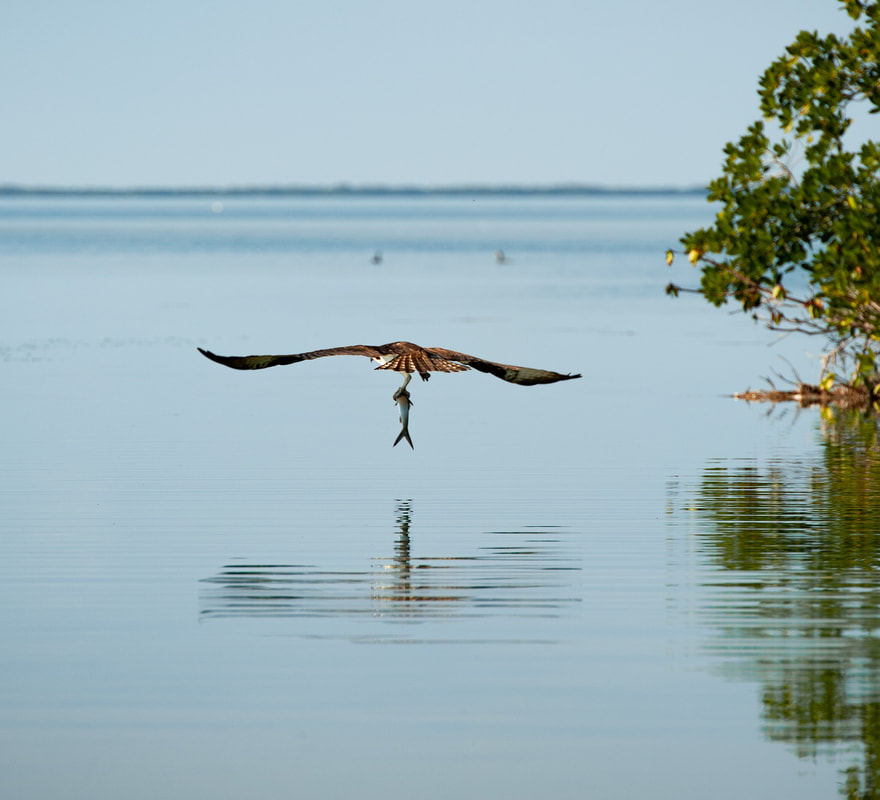 “Backcountry Osprey” - Carol Ellis Photo Osprey with Ladyfish catch in flight. One winter, when the birds are plentiful, I hired a guide to tour the Florida Keys Backcountry on his flats boat. The guide was skilled in finding birds, the only problem, the 500 horsepower announcement of our arrival, caused the birds to fly, which then resulted in a high speed pursuit from my perch in front of the center console, firing 10 continuous frames per second with my camera. A guide's reputation is only as good as the fish they catch, or in this case, birds that are sighted. We return to the dock with bird images captured, albeit flying away. Looking back at the experience, it is quite disturbing, for me to have disrupted the birds for the sake of a photo. The only consolation is, unlike James Audubon's artwork, I didn't have to kill the bird, in order to paint it. 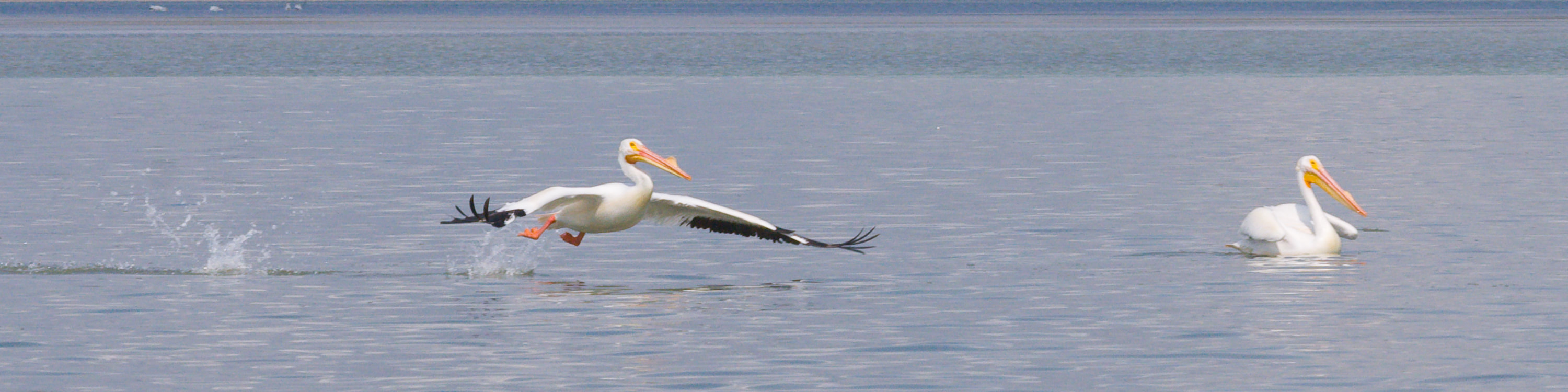 “White Pelican takes Flight” - Carol Ellis Photo White Pelican takes flight in Everglades waters. During July 2020, we're just emerging from Covid lockdown, and I get a call asking for help. My caller states he's undergoing cancer treatments and needs to focus on his camera to relieve some of his pain, and to feel productive. He wants to make a journal, and illustrate it with his photographs. At our first meeting, I thought I was there to solve some technical problem with the computer and the camera. By the third session with Joe the C.E.O. (I always promised to keep his identity confidential), I realized I was his teacher, and guiding light in this journey, which had no certain end. Joe was used to worldwide hunting excursions, and had impressive shots from those trips. But now with cancer, his travel was limited to what he could capture in his backyard. Fortunately for Joe, his backyard bordered on a wildlife refuge. where he was documenting the American Crocodile in the mangrove lined creek behind his house. Joe thinks the photos are not turning out so well. On first inspection, let's say his photos were extremely artsy. There was a little motion blur, camera blur, and a few photo filters added for good measure. Joe thought perhaps it's his camera. I viewed it as the challenges of low light photography, and just trying to make something good out of what he’s captured. I shared with him my recent experience involving my health, and how it affected my confidence and balance. I learned by attaching a mono-pod to my camera, my pictures would remain clear and in focus. I lent him my so called “photographer’s cane”, thinking perhaps his cancer treatments had affected his steadiness. 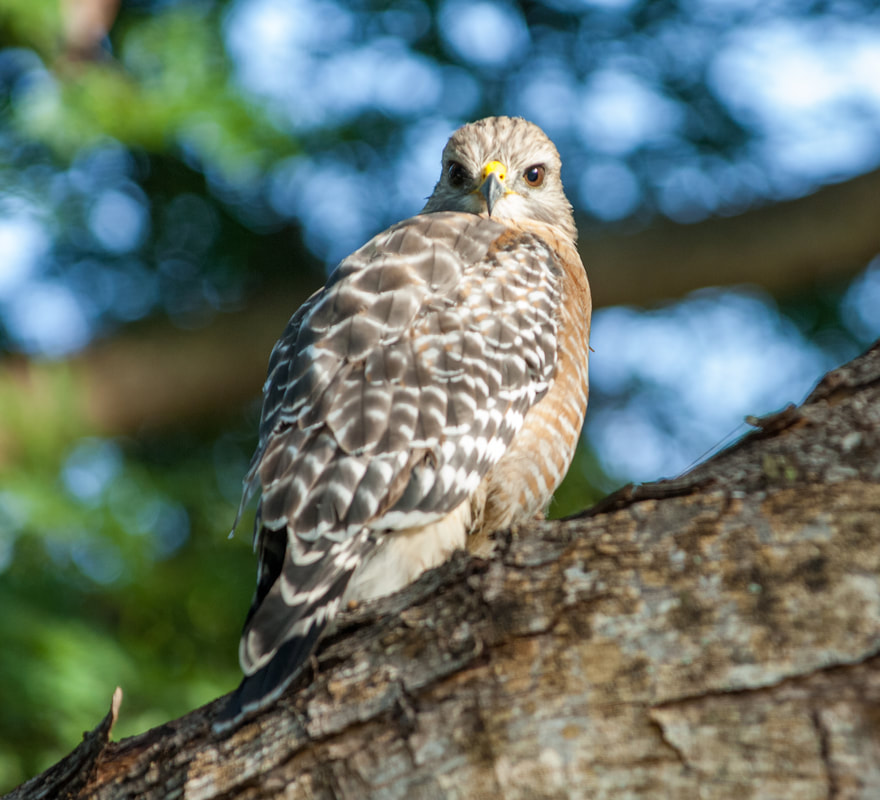 “Red Shouldered Hawk” - Carol Ellis Photo Red Shoulder Hawk, a year round resident, overseeing from a native hardwood tree. It’s main conservation threat is deforestation Immediately his photos improved. He went on to photograph with extreme competency an amazing array of species from his lanai, including Bald Eagle, Osprey, Crocodile, Heron, Egret, Red Shouldered Hawk, Red Cardinal, and Iguana. The images were compiled into a coffee table book, prefaced with Joe’s words, and then he put the camera away. Yes, away. Project complete. On time and a little over budget. Fast forward to Spring 2021, not too far from Joe's lanai, in a small pool of water next to a bridge, I encountered a diverse group of wading birds, just hanging out. A rare sight, I had to give it a shot, so I set up my tripod and Hasselblad medium format camera. So far so good, it is quiet, the birds are unfazed by my presence behind the cover of a green buttonwood branch. The resulting sepia tinted photograph I call the "Breakfast Club” and features our winter wading and shoreline bird visitors including Roseate Spoonbill, Wood Stork, Little Blue Heron, Green Heron, Tricolored Heron, Snowy Egret, White Ibis, and Great White Heron. 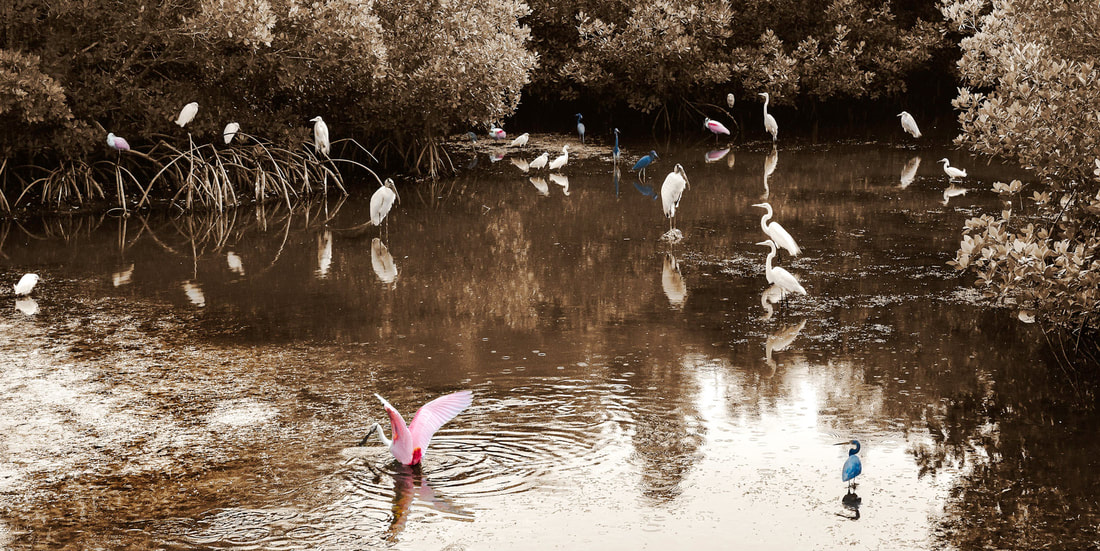 “Breakfast Club” - Carol Ellis Photo Sepia-tinted photograph of shoreline and wading birds congregating in a North Key Largo pond. Seeing these birds congregating within a residential community was a special experience. In 2020, scientists captured ten adult Roseate Spoonbills nesting in Florida Bay and attached cellular tracking devices so they could learn about their nesting and foraging habits. They’ve found the birds are using more ponds inside bay keys than the mangrove wetlands on the mainland that they historically preferred. Audubon incorporates trail cameras to monitor nesting success. The photos taken by the cameras are able to capture truly candid images of every movement these birds make. I cannot wait to learn more and hopefully see more birds in the future.
Joe passed this year. I miss him, however his memory lives on, whenever I sight birds in our midst. There are the visible and the invisible birds. There are the ever-present seagulls perching on channel markers, that follow a the boat’s wake, or swoop down on outdoor diners as they jockey for crumbs. Hungry pelicans float beside fish cleaning stations in eager anticipation of the scraps from returning anglers. Noisy red-bellied woodpeckers tap tap tap-ing on tree bark in search of small bugs that constitute their diet. The bright red male cardinal and mate, sporting a slightly duller flock of feathers, flit through the shrubs. The noisy grackles taunt the indoor cats through the screen enclosure, and consistently poop in the rain gauge. The mockingbird, Florida's state bird, and the mourning doves, with their coo-coo-cooing, are all familiar sights and sounds… living in our midst.  “Dockside Pelicans” - Carol Ellis Photo Brown Pelicans awaiting fish cleaning scraps. We find these birds not just in nature, also in our neighborhoods. The tall white egret named “sam” or “george” whose regular circuit of sea walls, docks and neighborhood parks have earned him notoriety. Same too, the white ibis, are at home on the tidal mud-flats, but also show up on our front lawns and green spaces, probing the grass with their long beaks for whatever hidden treats lie in the soil. Immature ibis are brown with a white belly. Like an ibis flock seen at a crosswalk, some are well adapted to asphalt, as are the roosters and hens in the Tradewinds parking lot. We don’t have to search them out… they are in our midst.  “Ibis in a Crosswalk” - Carol Ellis Photo Flock of Ibis in a crosswalk. In the northern end of the Keys, at the entrance to our island chain, lies the unique tropical habitat of the Upper Keys. Starting at the Circle K / mm 106, and extending 10 miles to the north is a two lane thoroughfare with bicycle path, called CR-905 or Card Sound Road. On each side is preservation land, I fondly refer to as the "hedge." On the west side of the road is Federal land, known as Crocodile Lake National Wildlife Refuge, on the east side of CR-905 is State preservation land, Key Largo Hammocks State Botanical site. Ever wonder what is behind that hedge? Fifty years ago it was all platted for development. There was a monster development planned called “Port Bougainville” just a mile north of the circle K, oceanside. Environmentalists and concerned folks, most notably conservationist Dagny Johnson fought for its protection. The goal of the acquisition was to connect parcels of nature, into one contiguous uninterrupted habitat. This preserved land contains an impressive collection of mature hammock, as well as recovering habitat, formally scarified and slated for development. The park entrance is designated by an arch left from the former “Port B” development, and portions are open to the public for passive recreational use such as walking and observing nature. One recent Sunday morning I met up with a group of naturalists at the entrance to “Port B”. They had cameras, and binoculars, smelled of “Keys Cologne” mosquito repellant, and were covered up with long sleeves, long pants and hats with mosquito netting. For the next hour or so, we ambled through the "Port B”. The slightest movement in the brush would cause us to stop in strict attention. Our Upper Keys habitat contains a rich diversity of native plants, found only here in North America and add to that the migrating species who feed and rest here on their journeys North and South. The depth of the naturalists observations made me realize, "where have I been?" Though I understand the importance of native habitat for sustenance of wildlife, and can recite facts from my reading, this was nature LIVE!  “Cape May Warbler” - Carol Ellis Photo Cape May Warbler in a Jamaican Dogwood tree in bloom. While learning about the plants and wildlife, the camera is a great tool for making positive identification. There is an app called iNaturalist where experts and researchers are quick to provide identification of plants and wildlife, simply from a photo and location provided from your phone. After an hour or so ambling through the "Port B", we opted to head south under the power lines next to the road. The sound of any songbirds were drowned out by the noise from the backed up line of cars trying to access US1. We pass a few littered sites, including old toilets, construction and household debris chucked into the woods. Flashback to what Card Sound Road used to look like pre-cleanup and park acquisition. We enjoyed a wonderful lunch at (another kind of bird) Buzzards Roost, talked about the morning’s discoveries, and shared photo successes. A wonderful meal and a park adventure, fresh air, and exercise provided me with a total reset. Nature, it was what attracted me to the Keys in the first place, and yes though it is forever changing and becoming “less rustic”, we must share with all our visitors and friends the importance of preservation of nature, not only to sustain wildlife, but also for our quality of life.  Carol Ellis has lived in South Florida her entire life and Key Largo for 37 years. She has a degree in Journalism from the University of Florida and is the resident photographer/artist at Ocean Reef Club. |
CAROL ELLIS
This photographic website provides me the opportunity for self-expression, for sharing Archives
October 2026
TAGS
All
|
 RSS Feed
HOME | THE ARTIST | TECHNIQUE & MEDIA | ART IN HOMES & PUBLIC SPACES | JOURNAL | CONTACT
© Copyright 2022. Carol Ellis Photography.
All Rights Reserved.
Web Development by: Mellowfish Media